At shoplab, we continually stay ahead of the curve, ensuring we're on top of all new features and updates that can elevate your eCommerce experience. Today, we're excited to share a significant advancement in Shopify's platform that allows for greater localization of your online store - translatable URL handles.
What Shopify changed
As of June 26, 2023, Shopify has enriched the eCommerce environment by enabling merchants to employ the TranslationsRegister GraphQL API. This innovation means you can register translations for resource handles, thereby creating localized online store URLs.
The brilliance of this update lies in providing a direct solution for localizing your shop's URLs. With just a few simple steps in the free Shopify app "Translate & Adapt", you can now translate your shop resource URL handles into different languages. This update is not just user-friendly but also significantly contributes to improving your shop's SEO, as localized URLs can enhance your page ranking in countries and regions that speak your selected languages.
How to switch on translatable URL handles
It's as simple as:
- Install the "Translate & Adapt" app from here.
- Go to the "Apps" tab in your Shopify dashboard and select the "Translate & Adapt" app.
- Select your desired language and navigate to Products.
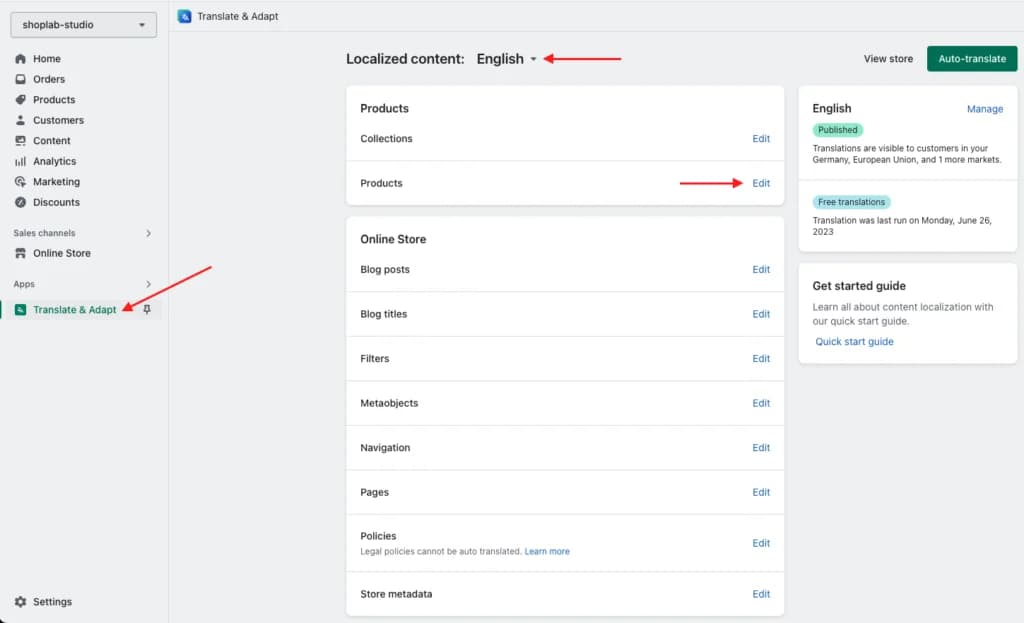
- Select a product and translate the URL handle to reflect your desired language.
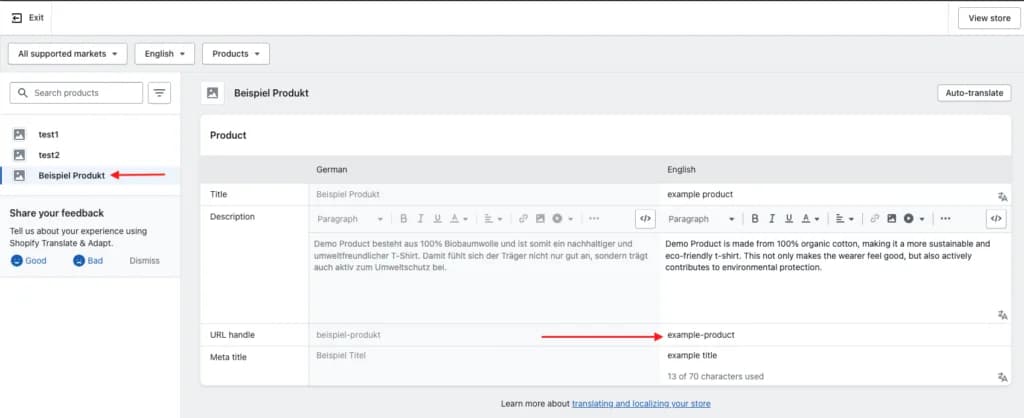
For instance, your product URLs can now be tailored as example.com/products/en-us/red-shoes for English-speaking customers and example.com/products/es-us/zapatos-rojos for Spanish-speaking customers.
This fantastic update extends across various resource types, including Products, Collections, Articles, Blogs, and Pages. Best of all, this change is supported across all API versions, ensuring it's accessible to all Shopify merchants.
Why this matters for international SEO
In summary, Shopify's now translatable URL handles represent a long-awaited update that holds high importance primarily for the search engine optimization (SEO) of your store. Your localized URLs can enhance your page ranking in countries and regions that speak your selected languages.
For localized URLs to actually pay off, your theme, your hreflang markup and your Markets configuration all have to line up - which is part of what our Shopify development covers. At shoplab, your trusted Shopify expert studio, we're dedicated to helping you harness the power of these new features. If you are not yet a shoplab client and are interested in a consultation, get in touch and we'll find a time that works. As always, shoplab stands by your side every step of the way.
For stores serving mainly the German-speaking market, this work is day-to-day business for our Shopify agency in Munich.