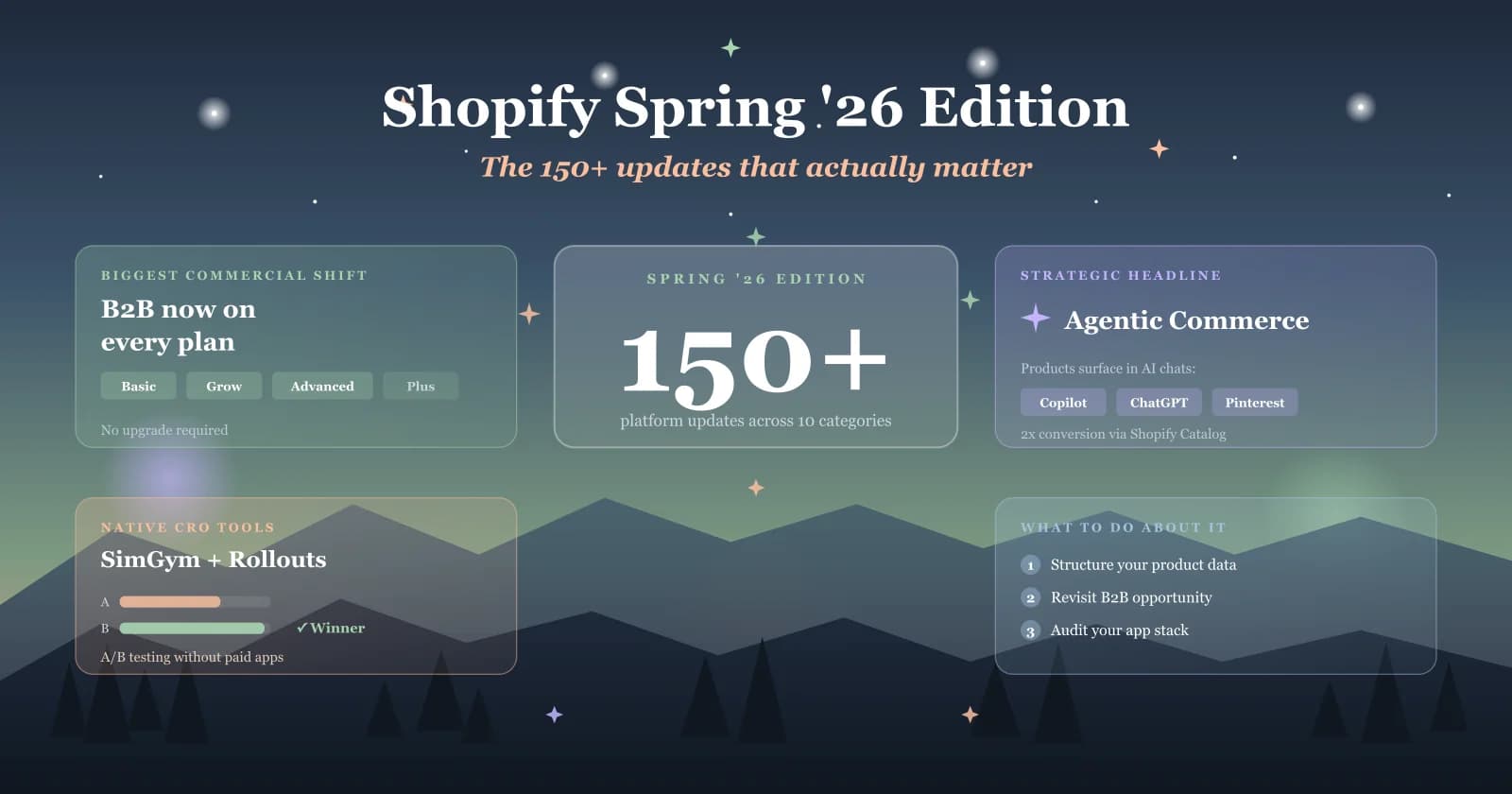
For years, native B2B functionalities on Shopify were tied to a Shopify Plus subscription. If you wanted to use company profiles, custom catalogs, or payment terms directly in your shop, you had to upgrade. That is now changing.
On April 2, 2026, Shopify announced that it is extending its core B2B functionalities to merchants on the Basic, Grow, and Advanced plans, at no additional cost. This is one of the most significant platform expansions Shopify has made for non-Plus merchants in recent years.
What specifically is changing
Previously, merchants on standard Shopify plans had no native way to manage wholesale and DTC from the same admin. Workarounds were cumbersome: separate storefronts, third-party apps, manual price adjustments, and orders handled via email or phone instead of self-serve checkout.
With this update, non-Plus merchants gain access to a feature set that has been developed and refined on Shopify Plus over almost four years:
- Company Profiles: dedicated accounts for wholesale buyers with their own login, custom pricing, and order history
- Up to three custom catalogs: tailored pricing and product selection for different wholesale customers
- Volume discounts and order rules: integrated pricing logic without an additional app
- Saved credit cards: wholesale buyers can store payment methods for subsequent orders
- Payment terms: offer Net 30, Net 60, or other conditions directly at checkout
Crucially: These features are seamlessly integrated into the tools merchants already use, Shopify Flow, Markets, and Shopify Payments now work for both B2B and DTC simultaneously from a single admin.
What Shopify Plus continues to offer
For merchants with more complex B2B structures, Shopify Plus continues to offer the full range of functionalities:
- Unlimited catalogs for highly individualized, customer-specific pricing
- Direct catalog assignment to individual companies and locations
- Partial payments and deposits at checkout
- Full access to all current and future B2B functionalities upon launch
The transition between plans is seamless, no replatforming is required if the business grows into the Plus segment.
Why this is important: The B2B opportunity is bigger than most merchants think
The global B2B e-commerce market is estimated at $36 trillion and continues to grow. For most Shopify merchants, this potential manifests in familiar moments: a retailer asks for wholesale prices, a customer wants to buy in larger quantities, a trade show opens a new sales channel.
Data from merchants already using Shopify B2B shows what's possible when the right infrastructure is in place:
- Up to a 4.1x increase in reorder frequency compared to DTC orders
- Up to 33% more self-serve orders within the first six months
- Up to 20% higher reorder rate overall
DAX Eyewear is a good example. When founders Channing and Justin Dyson launched the brand, wholesale wasn't part of the plan. A single trade show changed that, and B2B quickly became the company's growth engine. Without native tools, however, errors crept in: wholesale buyers sometimes saw retail prices and didn't order at all.
"If you can't trust the data, you can't make good decisions," says Justin.
After switching to Shopify B2B, buyers could log in and order themselves, no more workarounds, no price confusion. "It would have been enormously helpful if there had simply been native B2B functions on a regular plan," says Justin.
The true cost of disconnected tools
Before this update, the only options for non-Plus merchants who wanted to do wholesale were expensive, error-prone, or both:
- Locking parts of the shop behind a password or login redirect
- Managing wholesale prices via a separate app or spreadsheet
- Manually processing B2B orders via email or phone
- Running two separate Shopify stores, one for DTC, one for wholesale
Each of these approaches creates friction: duplicated administrative effort, data in multiple places, and buyers who cannot order themselves. Snyder Performance Engineering, an automotive parts manufacturer, experienced this firsthand. Previously, every B2B order required a call or email, which severely limited the number of accounts they could handle.
After switching to native Shopify B2B, wholesale customers could browse products, view their prices, and order independently for the first time. Orders automatically synced with back-office systems.
"When someone places an order, it can literally be packed and shipped within minutes," says Amy Snyder. "That's a big difference in wholesale."
The result: 25% less time spent on back-office tasks and 40% higher average customer spending.
Who this update is relevant for now
This update is immediately relevant for three types of merchants in particular:
- DTC merchants who already receive wholesale inquiries: if buyers are already asking, native tools are now available to serve them professionally without a plan upgrade
- Merchants who handle B2B via workarounds: custom apps, locked pages, manual price maintenance, now is the right moment to switch to a clean native setup
- Merchants evaluating Shopify and previously assuming that B2B required Plus, this assumption no longer applies
How to get started
Shopify B2B is now being rolled out to all plans. Here's how to get started:
- In Shopify Admin → Customers → Companies, create the first company profile
- Under Products → Catalogs, create a custom catalog with wholesale prices
- Configure Payment terms at the company level in the profile settings
- Activate B2B login so wholesale buyers can access their account and order themselves
If you are migrating from an existing workaround solution, a third-party app, a separate store, or manual processes, you should check what is in place before migrating to ensure that prices, customer data, and order history are transferred cleanly. That part is exactly what our Shopify development work covers.
Whether B2B makes sense on your current plan is something we usually work out in strategy consulting — alongside the question of what else Shopify brings to your business model.
Conclusion: One platform for everything
Shopify's B2B expansion to all plans is not just a feature update; it's a signal of where the platform is heading. The artificial separation between B2B and DTC commerce is disappearing, and merchants who operate both from a unified platform will have a clear operational advantage.
If wholesale is already part of the business, or an opportunity that has been postponed until now, now is the right time to set it up properly. If you want a second pair of eyes on it, talk to us.
More on this directly from Shopify: Shopify brings native B2B features to millions of merchants →