Skip to content
Back

Shopify News

Shopify Winter '26 Editions: The Renaissance of Commerce

· 4 minutes reading time

Portrait of Mark Chang, shoplab founder and CTO

Mark Chang

Founder & CTO

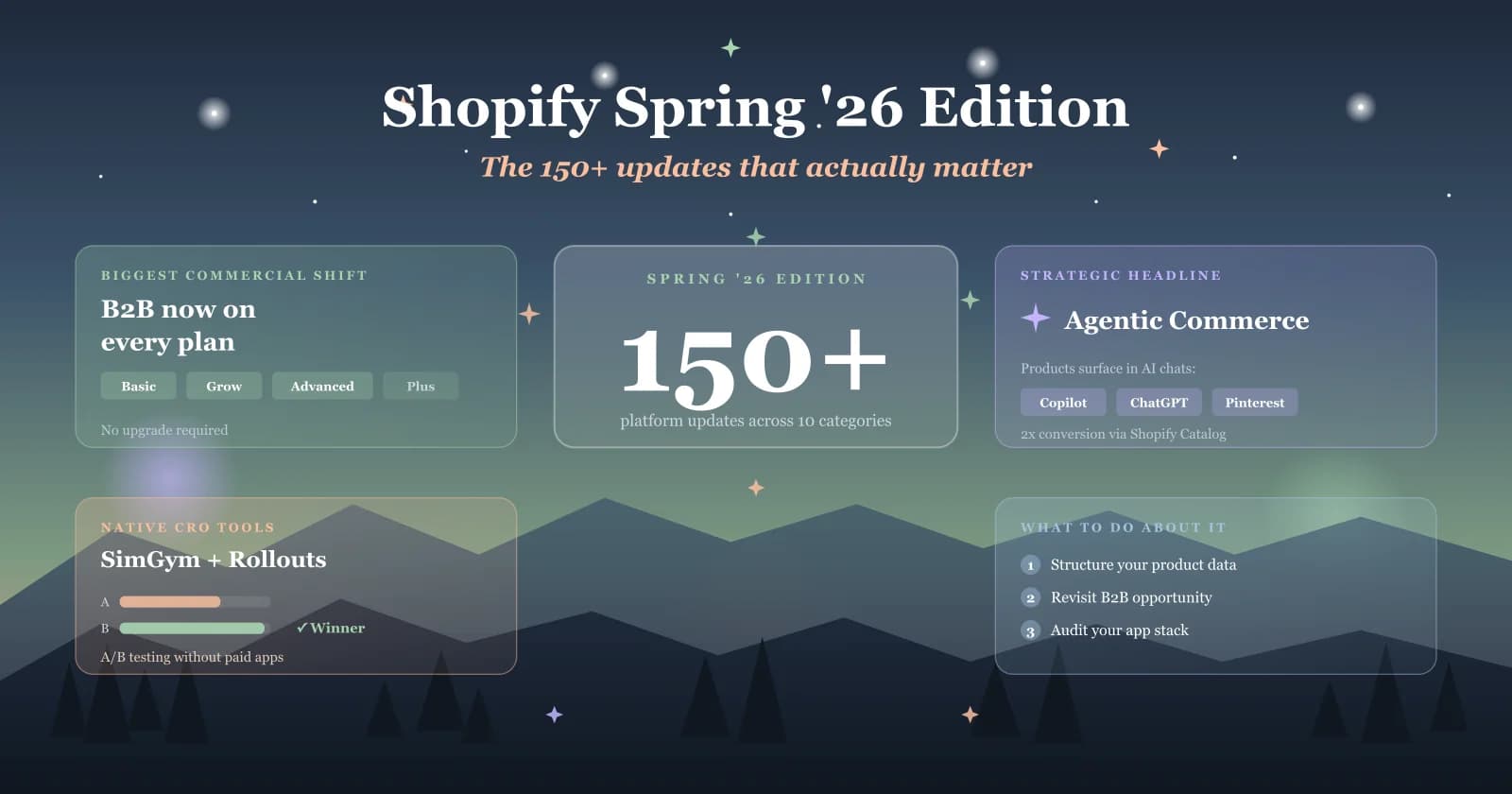
Shopify has officially released its Winter '26 Edition, and it's packed with features. With more than 150 updates, Shopify is ushering in a new era for merchants, which the company calls a Renaissance: smarter AI, faster workflows, a more personalized shopping experience, and tools that significantly reduce the time spent growing a business.

Here are the updates we're most excited about, and what they mean for merchants in the future.

Sidekick Levels Up: Your New AI Business Partner

Shopify's AI assistant Sidekick has evolved from a simple helper to a proactive partner that can actually perform tasks, rather than just providing guidance.

What's new:

  • Sidekick Pulse provides continuous insights, recommendations, and directly actionable next steps.
  • Natural language theme editing allows commands such as "Create a 4-column product grid" - and the change is implemented immediately.
  • Custom app generation creates Shopify apps based on simple text input.
  • Automated workflows no longer require any programming knowledge.
  • Studio-quality image editing improves product photos in no time.

This is the most powerful AI for merchants that Shopify has ever released.

More information: Sidekick in the Shopify Winter '26 Editions

Agentic Storefronts: Your Products in AI Chat Platforms

Shopify now allows your products to appear directly in conversations on ChatGPT, Perplexity, and Microsoft Copilot.

This means that buyers can discover and purchase your products while chatting with an AI - without ever having to visit your website before.

A single setup in Shopify makes your brand searchable across multiple AI platforms. How to position your store and your product data for this is what we work through in strategy consulting.

More information: agentic commerce in the Shopify Winter '26 Editions

SimGym: Test Your Store With AI Shoppers

SimGym functions like a flight simulator for your online store.

Before releasing major changes, AI shopper personas - based on data from billions of real transactions - test how customers might behave.

Ideal for:

  • A/B testing designs
  • Predicting changes in conversion rate
  • Avoid risky redesigns

More information: the online store chapter of the Shopify Winter '26 Editions

Rollouts: Schedule & Test Live Store Changes

Shopify now offers integrated A/B testing and scheduled theme updates directly in the admin area - no third-party tools are required.

You can:

  • Testing a new homepage
  • Plan campaign layouts in advance
  • Comparing the performance between two versions

This brings real experimentation to every Shopify store.

More information: Rollouts in the Winter '26 Editions online store chapter

Shopify Product Network: One-Click Catalog Expansion

When shoppers search for something you don't carry, Shopify can now display products from other Shopify Merchants - and you earn a commission.

Think of it as a way to give your store an endless inventory without having to hold stock yourself.

A huge benefit for product discovery and increasing conversions.

More information: the marketing chapter of the Shopify Winter '26 Editions

POS Hub & Retail Upgrades

For retail merchants, Shopify has introduced a new POS Hub that simplifies wired connections to tablets and accessories - no more pairing problems, no more instability.

The new features include:

  • Rock-solid connection for scanners, printers and cash drawers
  • Integrated health monitoring and automatic system recovery
  • Simultaneous support for multiple peripheral devices

Plus: Selling subscriptions directly in the store, faster inventory counts, improved payment support, and the expansion of Tap to Pay to more countries.

More information: the retail chapter of the Shopify Winter '26 Editions

Tinker: AI Creative Tools in Your Pocket

Tinker is Shopify's new mobile creative app that uses AI to create graphics and designs - even if you're not a designer.

Ideal for:

  • Product mockups
  • Social media assets
  • Brand visuals

Creators and small businesses benefit massively from this “Blank Canvas Killer”, which solves the problem of the blank canvas.

More information: Tinker in the Winter '26 Editions retail chapter

Other notable updates

Here are some additional improvements worth mentioning:

Storefront & Product Enhancements

  • Up to 2048 product variants
  • Theme generation on mobile
  • Over 250 Horizon theme enhancements
  • Unlisted product status
  • Improved collections & discount logic

Marketing Upgrades

  • SMS marketing inside Shopify Messaging
  • Auto-translated forms
  • Improved customer segmentation
  • Dynamic product sections in emails

Checkout & Accounts

  • Shop Pay Installments in more regions
  • Country-specific checkout customization
  • Apple Pay in Shop Pay

Operations & Analytics

  • Flexible inventory transfers
  • Heatmaps & enhanced reporting
  • Smarter bot filtering
  • Multi-store analytics (Plus)

Conclusion: A true renaissance for Shopify merchants

This Winter '26 edition feels like a turning point. Shopify isn't just adding new features - it's redefining how merchants build, test, launch, and scale their businesses. It's doing so with AI-powered tools that would have been unthinkable just a few years ago.

For shop owners, this means:

  • Less time spent on manual tasks
  • Smarter decisions thanks to AI-powered insights
  • Higher conversions through better testing options
  • Faster production of creative content
  • More resilient retail processes

Learn more about the event here: Shopify Winter '26 Editions

If you need help implementing these new features for your store or your customers, shoplab will be happy to advise you - our Shopify development team takes it from theme work through to rollout.

The wider frame for this — what the platform covers today and where its limits are — is on our Shopify overview.


Got questions?

Let's clear things up!

We've gathered the most asked questions with answers to help you better understand our services.

Portrait of a shoplab team member

Still have a question?

Let's have a call and clear things up.

Yes. We have worked exclusively with Shopify and Shopify Plus since 2020, and turning down other platforms is what got us here. The trade is deliberate: a team that sees the same platform every day knows which problems have a native solution, which need an app, and which need custom code - so less of your budget goes into rediscovering that. It also means we follow Shopify's own conventions instead of porting patterns over from Magento or WooCommerce, which is what keeps a store upgradeable after we hand it over.

Strategy & consulting, custom Shopify theme development, custom app development, store migrations, UX/UI design, integrations & middleware, ongoing store management, and AI e-commerce readiness. Most projects combine three or four of those: a migration usually arrives with an ERP integration and a redesign attached, and a redesign usually surfaces a performance problem. Everything runs through one team, so a design decision and its development consequence get settled together rather than negotiated between two agencies.

Absolutely, and it is one of the most common ways clients start with us. We audit the current store first - conversion path, page performance, and the templates that carry the most revenue - then redesign against what the audit found rather than against a moodboard. Your products, customers, orders and URL structure stay where they are, so rankings and store data are not at risk. Redesigns can also ship in stages: the pages that sell first, the rest afterwards, so you see the effect before the whole budget is committed.

Yes, from scratch rather than by reskinning a marketplace template. A custom theme means the sections your merchandising team actually needs, editable in the theme editor without a developer, and no inherited code for features you will never use. That last part is the performance argument: off-the-shelf themes carry the union of every use case they were sold for, and you pay for it in Core Web Vitals on every page load. We build against your catalogue and your content model, then hand over documentation so your team can run it.

Yes - WooCommerce, Magento, Shopware and other platforms, in a staged, low-risk process. Products, variants, customers and order history come across, and every indexed URL gets a mapped 301 so the rankings you already earned survive the move. What decides the timeline is rarely catalogue size: it is data structures with no direct Shopify equivalent (bundles, configurable products, customer-specific pricing) and the systems your store talks to. We inventory both before a cutover date is set, which is why our migrations do not end with a redirect list written the night before launch.

It depends on scope: focused improvements often take 4-6 weeks, while full custom builds or migrations typically run 8-16 weeks. A store moving onto a configured theme is usually live in 4-8 weeks; a fully custom storefront runs closer to 10-16. You get a timeline with defined milestones before we start, and those milestones are staged releases rather than one launch date at the end - so a delay in one area does not push everything behind it. What moves a timeline most is late scope additions and integrations nobody inventoried at the start.

Always. We design mobile-first because that is where most e-commerce traffic sits, and where most of the conversion loss happens. Every store is tested on real devices rather than a resized browser window, and measured against Core Web Vitals - largest contentful paint, interaction latency, layout shift - before it goes live. Image handling, font loading and third-party scripts get the most attention, because apps are usually what turn a fast theme into a slow store. Performance is a launch requirement here, not a follow-up ticket.

Yes. Store management plans cover Shopify and app updates, iterative improvements, testing and technical support, on a monthly scope you can adjust as priorities change. Most stores need the first weeks after launch more than they expect: real traffic finds edge cases staging never produced, and the analytics only start telling the truth once volume arrives. After that, ongoing work tends to be conversion iterations on the templates that carry revenue, seasonal campaign support, and keeping the theme current as Shopify ships platform changes.

Definitely, and we will say so when a rebuild is not the right call. We often work in focused iterations - a conversion audit, performance optimization, or redesigning the handful of templates that carry most of the revenue - shipped as staged releases with measurable outcomes instead of a big-bang relaunch. For a store that already converts this is usually the better economics: you keep what works, spend where the data points, and avoid the risk window a full replatform opens. A rebuild earns its cost when the underlying theme or data model is the actual constraint.

Book a free strategy call - about thirty minutes, and you keep whatever comes out of it. We ask what you run today: platform, catalogue structure, connected systems, and what should be better after the project. From there you get a written proposal covering scope, timeline and pricing, with named work blocks rather than one number. If the call shows that what you need is smaller than an agency project, we will tell you that too. It is a cheaper conversation for both of us than finding out in month two.

Read more questions

Get in touch