Shopify Editions returned this spring with another major release, featuring over 150 updates across ten categories, from Agentic Commerce and AI tools to Retail, Payments, Finance, and Developer infrastructure. The Spring '26 Edition is one of the most comprehensive releases in recent memory and signals Shopify's direction: becoming a platform that sells everywhere, including in AI chats, and where merchants increasingly rely on built-in tools instead of paid apps.
This recap highlights what's genuinely new, but more importantly: which of these 150 updates are actually relevant for your store. Not every release deserves your attention. The few that do are worth understanding correctly, as some subtly change the economics of a Shopify store in the background.
The Big Picture: Shopify Wants to Sell Everywhere
The leitmotif of Spring '26 is Agentic Commerce. Shopify is strongly pushing for products to be found and purchased within AI chats, currently in Copilot, soon in Meta-ads, via Shopify Catalog, and a new "Universal Commerce Protocol." Shopify states that data syndicated through Catalog in AI chats achieves 2x the conversion rate compared to non-syndicated data.
Whether you're already considering selling in ChatGPT or not, this is the conversation merchants will increasingly hear: customers don't always start in a store anymore. They start with a question to an AI, and the AI decides which products become visible. Merchants whose product data is clean, structured, and well-organized are the ones whose products will be recommended.
That's the strategic background for the entire release. Now, for the updates that truly make a difference.
The Biggest Commercial Shift: B2B Now on All Plans
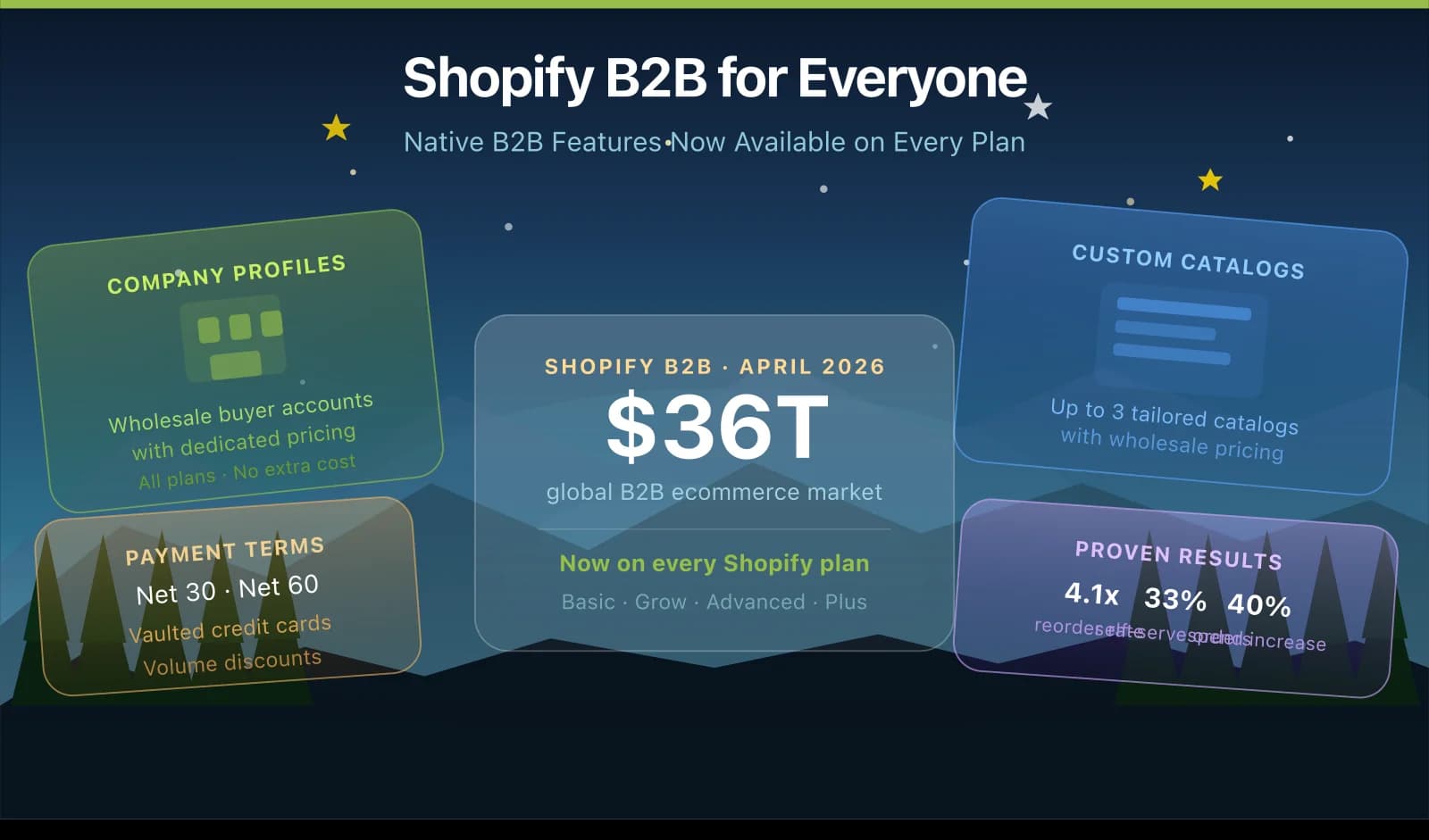
This is the most commercially significant update of Spring '26, for both agencies and merchants. Native B2B features, company profiles, quantity discounts, up to three B2B catalogs, market-specific B2B settings - are now available on Basic, Grow, and Advanced. Previously, these were Plus-exclusive.
What this means in practice:
- Merchants operating D2C and wholesale in the same store no longer need to upgrade to Shopify Plus just to access B2B features.
- Smaller wholesale setups, for which the Plus price was never justified, can now be set up natively, without workaround apps.
- QuickBooks and Mailchimp now natively support B2B orders, PO numbers, and B2B-specific segments.
- Shopify Flow can automatically debit stored B2B payment methods, triggered by fulfillment, due dates, or invoicing.
Especially for DACH merchants, where wholesale accounts for a significant portion of many businesses, this lowers the barrier to operating B2B cleanly on Shopify. If your store has been handling its wholesale business outside of Shopify because the Plus upgrade wasn't worth it, that calculation has changed.
Native CRO: SimGym and Rollouts
Two updates in this release subtly change how merchants can optimize their stores without expensive third-party tools.
SimGym analyzes a single theme with AI-simulated shoppers and provides ideas for improvements. It works on any theme, not just Shopify's own. For stores too small to conduct statistically reliable A/B tests with real traffic, this provides a structured basis for CRO without needing live data.
Rollouts allows you to publish theme changes, checkout configurations, or customer account setups at a scheduled time - or run them as native A/B tests. This is a real workflow change. Theme launches and checkout adjustments that previously required workarounds with third-party A/B testing apps can now be staged and tested directly in the Shopify Admin. It also works with localized themes, so you can translate a theme and cleanly plan market-specific rollouts.
For merchants who paid for A/B testing apps just to compare two checkouts or two theme variants, this is one of those moments where the platform integrates functionality that previously cost extra.
Operational Improvements That Quietly Save Time
A series of updates aren't spectacular but solve chronic pain points for merchants:
- Variant-specific Publishing: You can now control which product variants are live per channel and per market, without workarounds. Sounds small, but it was requested for years.
- Stack Multiple Product Discounts: A percentage discount and a fixed amount discount on the same product in one order. Resolves many promo logic headaches.
- Discounts by Market: Run targeted promotions for specific regions, retail locations, or B2B setups separately.
- Redesigned Customer Accounts: Redesigned account pages with brand-consistent sign-in, recommendations for first-time buyers, and 365-day sessions. Customer data can now be synced from identity providers like Auth0, Ping, and Azure ID, opening up enterprise and B2B SSO discussions.
- Better Online Store Editing on Mobile: The Shopify Mobile App now has a persistent preview during editing and built-in Sidekick. Small change, but merchants who edit on the go will notice it.
- Smarter Storefront Search: Search now tolerates typos and unusual phrasing. Quietly reduces the need for a paid search app for smaller stores.
- Product Compliance Notices: Mandatory warnings displayed in the store, AI channels, and the Shop App. Relevant for regulated product categories.
Marketing & Analytics: AI Enters the Marketing Stack
Campaign Autopilot is Shopify's new AI-powered cross-channel marketing tool. It learns, optimizes, and drives performance across multiple channels, with guardrails set by the merchant. Whether it replaces existing marketing platforms for serious merchants remains to be seen - but for stores running their marketing by gut feeling, it provides a starting base.
Shop Campaigns now run on ChatGPT, Pinterest, and Microsoft Monetize, expanding reach beyond the original channels. WhatsApp Marketing is now a native channel in Shopify Messaging, and SMS automations are also available.
On the analytics side, the Admin gets new data visualizations (scatter plots, radar charts, bubble charts, sunbursts), automatically surfacing daily insights, chart annotations that explain why metrics changed, metric targets you can track visually, and the ability to filter analytics by metafields. Reporting deliverables are easier to assemble - and individual merchants get more context for their numbers without needing a separate BI tool.
The Retail and POS Side
Shopify is doubling down on its retail efforts. POS v11 is touted as Shopify's fastest yet - with customer creation in under a minute, faster search, and persistent carts. Returns, exchanges, and new sales now occur in a single cart - with Smart Grid Actions. Scannable discount QR codes, generated in the Admin, can be scanned at the checkout. The Verifone Victa Mobile is a new handheld device for US and Canada that transforms into a terminal when docked.
For DACH retailers specifically: DHL Kleinpaket (small parcel) is now supported as a cheaper shipping option for packages under 1 kg in Germany - a small but practical update.
Notable Payment and Checkout Updates
A few payments updates relevant to European merchants:
- VAT ID Validation in Checkout: Capture and validate buyers' VAT IDs directly in the checkout in the EU and UK via Shopify Tax. Important for B2B-heavy stores.
- Shop Pay on Any Platform: Businesses not using Shopify's online store can offer Shop Pay at checkout, with simplified onboarding.
- Redesigned, conversion-stronger Checkout: More compact layout, clearer shipping options, more prominent Pay button, less scrolling on mobile. Native to Shopify Checkout, no opt-in needed.
- Shipping and Pickup in One Checkout: Customers can choose shipping for some items and pickup for others within the same order.
For Developers: A Release with Two Stories
The Developer section of Spring '26 is the most extensive single block of the release and tells two stories. The first is the AI and Agentic Tooling thread: the Shopify AI Toolkit, store management via agents in Claude/ChatGPT/Perplexity, agent-enabled Hydrogen rebuilt with Vercel, and Vibe-Coding integrations with Lovable, Replit, V0, and Manus.
The second thread is more interesting for agencies and merchants alike: Shopify is subtly lowering the cost of individual development work. App Home without a Backend means that individual admin tools can now be built without their own server. The new Collections API automates collection logic with variant conditions and exclusion rules, a sleeper hit for catalog-heavy stores. Metaobject data in Checkout Functions means that individual checkout logic now has access to your structured data, which naturally connects to the B2B push.
For agencies, this practically means: things that previously required a hosted app, a backend, or messy workarounds are now native - and cheaper to implement. Custom work that was previously not economically viable now is.
What This Edition Really Means for Your Store
Looking at the entire picture across all 150+ updates, three insights are relevant for most merchants:
1. The Structure of Your Product Data Becomes a Competitive Advantage
Between Agentic Commerce (where AI agents read structured data to recommend products), the streamlined Metaobjects/Metafields API, and the ability to filter analytics by metafields, structured product data has gone from "nice to have" to "how your store is found and evaluated." Merchants who treat product data as marketing copy will increasingly lose out to merchants who treat it as structured information.
2. The B2B Opportunity Has Grown Significantly
If you've been running wholesale with workarounds because Shopify Plus wasn't worth it, the calculation has changed. Native B2B on Basic, Grow, and Advanced, with native QuickBooks and Mailchimp support - means that most merchants can now run a clean B2B operation on the plan they already have. This is the update most likely to deliver real value fastest, if it's relevant to you.
3. Some Paid Apps Are Now Less Necessary
Native A/B testing (Rollouts), smarter storefront search, mobile theme editing with built-in AI support, theme analysis without traffic (SimGym), and discount stacking replace functionalities for which merchants previously paid third-party providers. It's worth spending an hour once a quarter to cross-reference your current app stack against what is now native. Apps that were valuable in 2022 might simply be duplicated for free by Shopify in 2026.
Conclusion: A Release That Calls Merchants to Action
Most Shopify Editions are interesting to read. Spring '26 is interesting to act upon. The B2B change on all plans alone is reason enough for many merchants to reconsider their store setup. The CRO tools shift how stores can optimize without app dependencies. The Agentic Commerce push gives every merchant a strategic question - even if they don't act immediately.
The 150 updates are not all equally important. The few that are deserve serious attention, not because Shopify is urging you to act, but because the costs of inaction will accumulate over the next twelve months. Stores that lean into B2B, clean up their product data, and divest from paid apps that have been natively replaced will be in a stronger position than stores that skim the release notes and continue as before. Our Shopify development team handles the store-side work; strategy consulting handles the question of which updates matter for your business model at all.
For the updates you can only exploit with your own logic, building a custom Shopify app is usually a more direct route than yet another third-party tool.
More on this directly from Shopify: Shopify Editions Spring '26 - 150+ Updates to Sell, Shop, and Build Everywhere →